.jpeg)
EarthNet · Planetary Intelligence
Observe the planet.
Understand the chain.
Nine monitoring engines provide a live view across environmental and infrastructure domains. The next stage is a causal layer designed to explain relationships, model consequences and test interventions.
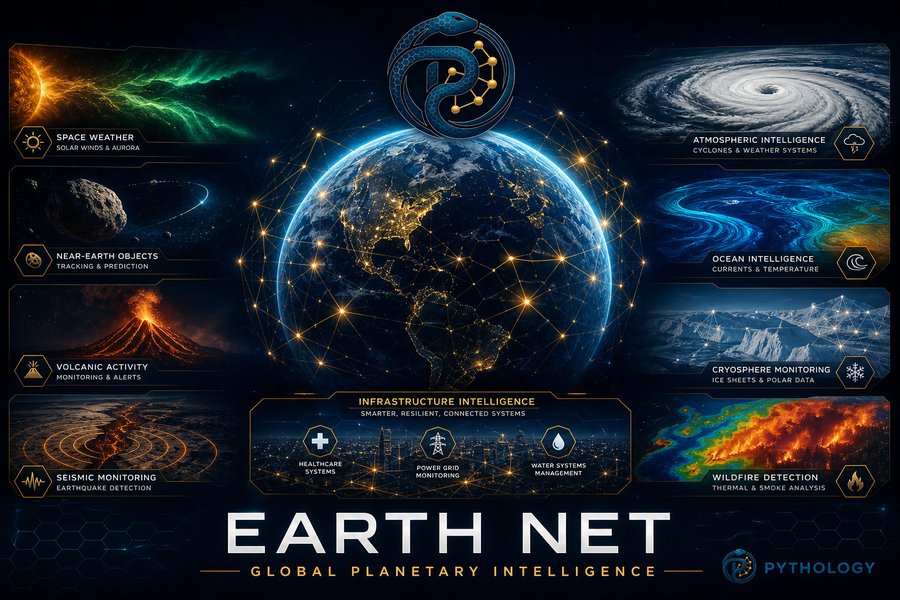
Current capability
Nine engines.
One planetary view.
EarthNet brings heterogeneous environmental and infrastructure signals into a common operating surface.
Seismic and volcanic
Earthquake activity, significant events, volcano alerts and regional context.
Objects and space weather
Near-Earth objects, solar and geomagnetic conditions affecting planetary systems.
Weather and atmospheric hazards
Severe conditions, heat, storms, atmospheric stress and emerging hazards.
Marine-system health
Ocean conditions, marine anomalies and environmental change across connected waters.
Ice and frozen systems
Signals from glaciers, sea ice and other frozen components of the Earth system.
Wildfire, flood and infrastructure
Hazard events and the human systems exposed to cascading consequences.
EARTHNET
The causal layer
Monitoring is the beginning, not the outcome.
Causal EarthNet is intended to move from event awareness toward questions that matter for response: what is driving the change, what may be affected next and which action could alter the outcome?
Architecture of action
From signal to intervention.
The planned intelligence chain remains explicit about evidence, uncertainty and competing explanations.
Detect and organise
Ingest events, measurements and anomalies across independent engines.
Build relationships
Identify temporal, spatial and system-level connections across domains.
Test plausible causes
Compare candidate causal pathways and expose evidence against them.
Estimate consequences
Model likely downstream effects, timing, exposure and uncertainty.
Run counterfactuals
Compare what may happen under alternative interventions or delays.
Inform human decisions
Present evidence, alternatives and limitations for accountable review.
Potential applications
Where connected consequences matter.
The platform is designed for high-consequence environments in which isolated dashboards miss system interactions.
Flood and wildfire
Propagation, evacuation, exposure and intervention comparison.
Infrastructure chains
Dependencies, cascading failure and recovery priorities.
Ocean and land systems
Environmental stress, resource change and cross-domain effects.
Environmental pressure
Heat, smoke, disruption and pressure on communities and services.
Commercial and government deployment
Discuss the problem EarthNet needs to solve.
Deployments may involve jurisdiction-specific data, private infrastructure, custom causal models and secure integrations.